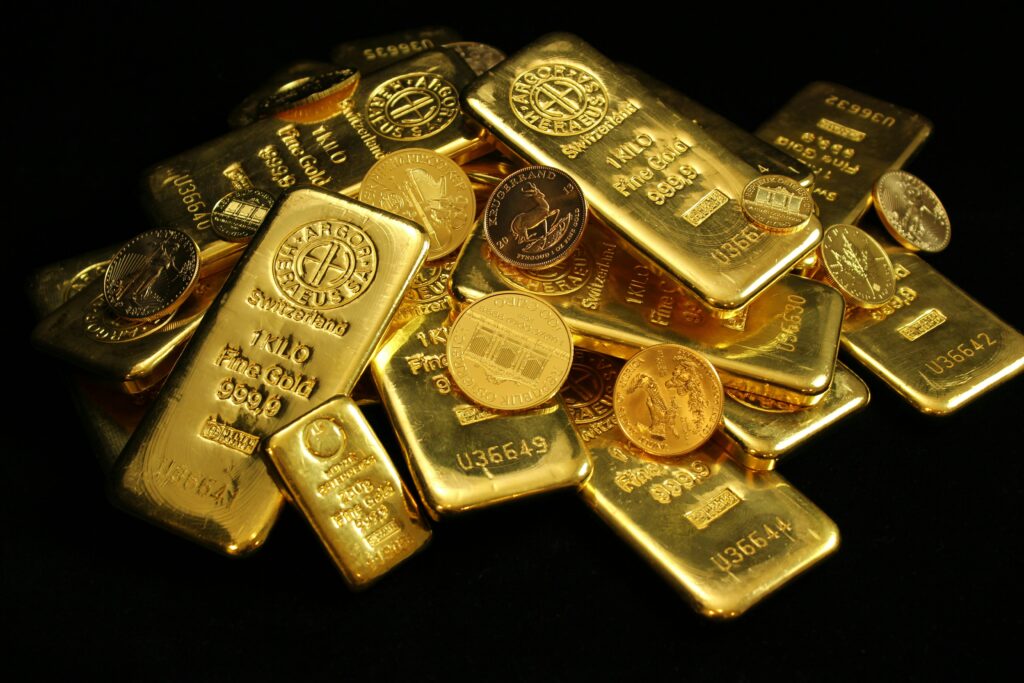

Gold recently surpassed $5,500 per ounce for the first time. After climbing more than 60% in 2025 and continuing its surge into 2026, the metal has attracted enormous attention from investors seeking safety in uncertain times.
Warren Buffett is not among them.
The legendary investor has spent decades articulating why he avoids gold, always returning to the same simple question: does this asset actually produce anything? His quotes on the topic remain some of the clearest thinking available on what separates productive investments from speculative ones. (For a broader collection of his wisdom, see our overview of Warren Buffett quotes on investing.)
Why Buffett thinks gold is absurd
Buffett’s most colorful critique of gold came during a 1998 speech at Harvard.1 He told the audience:
“Gold gets dug out of the ground in Africa, or someplace. Then we melt it down, dig another hole, bury it again and pay people to stand around guarding it. It has no utility. Anyone watching from Mars would be scratching their head.”
The image is deliberately ridiculous. Humans expend enormous resources extracting a soft metal from the earth, only to refine it and lock it away underground again. No goods produced. No services delivered. No one fed. Buffett returned to this idea for decades because it captures his core objection. Gold doesn’t do anything.
How gold fails to grow
Buffett expanded on the theme in his 2011 letter to Berkshire Hathaway shareholders,2 placing all investments into three categories: currency-based assets like bonds, nonproductive assets like gold, and productive assets like businesses and farmland. Gold landed squarely in the second group.
He called gold “a way of going long on fear,” and pointed out the fundamental problem with owning it:
“If you own one ounce of gold for an eternity, you will still own one ounce at its end.”
That single sentence captures the difference between gold and a productive asset. A share of stock represents partial ownership of a business that can reinvest profits, expand into new markets, and compound its earnings over time. An ounce of gold just sits there. It can go up or down in price, but it cannot generate returns on its own.
What motivates gold buyers
In that same 2011 letter, Buffett offered a pointed observation about the psychology behind gold purchases:
“What motivates most gold purchasers is their belief that the ranks of the fearful will grow.”
This is a crucial distinction. When someone buys stock, they’re betting on a business producing goods, earning revenue, and growing over time. When someone buys gold, they’re wagering that more people will become afraid, driving up demand for a perceived safe haven. Gold is often framed as the ultimate inflation hedge, but Buffett sees its value as dependent on sentiment, not fundamentals.
Buffett acknowledged this bet has sometimes paid off. Fear does periodically sweep through markets. But building a long-term strategy around the expectation that the world will become more frightened is a fragile foundation.
A thought experiment about gold versus productive assets
Buffett’s most famous illustration appeared in a February 2012 Fortune article adapted from his shareholder letter.3 He asked readers to picture all the gold in the world melted into a single cube, then consider what else they could buy for the same money:
“Today the world’s gold stock is about 170,000 metric tons. If all of this gold were melded together, it would form a cube of about 68 feet per side. (Picture it fitting comfortably within a baseball infield.) At $1,750 per ounce, its value would be $9.6 trillion. Call this cube Pile A.
Let’s now create a Pile B costing an equal amount. For that, we could buy all U.S. cropland (400 million acres with output of about $200 billion annually), plus 16 ExxonMobils (the world’s most profitable company, one earning more than $40 billion annually). After these purchases, we would have about $1 trillion left over for walking-around money (no sense feeling strapped after this buying binge). Can you imagine an investor with $9.6 trillion selecting Pile A over Pile B?”
A century from now, the farmland will have produced staggering amounts of crops. The ExxonMobils will have delivered trillions in dividends. The gold cube will be exactly the same size, still incapable of producing anything.
Why Buffett prefers businesses over gold
At the 2018 Berkshire Hathaway annual meeting,4 Buffett drew the contrast simply:
“A farm has utility. An apartment house has utility. A business will produce earnings.”
Gold, by comparison, “hasn’t worked very well,” and he saw “no reason why it would work well in the future.”
He backed it up with numbers. Imagine investing $10,000 in March 1942. Put into an S&P 500 index fund, that money would have grown to roughly $51 million by 2018. Put into gold, it would have become about $400,000.
As Buffett put it:
“For every dollar you could have made in American business, you’d have less than a penny of gain by buying into a store of value which people tell you to run to every time you get scared by the headlines.”
The math is hard to argue with. Over long periods, productive businesses have generated returns that dwarf gold’s price appreciation. Businesses reinvest, innovate, and compound. Gold cannot.
What about the time Berkshire bought a gold stock?
Any honest discussion of Buffett’s Warren Buffett gold quotes should mention an episode that surprised the investment world. In the second quarter of 2020, amid the COVID-19 pandemic, Berkshire Hathaway purchased roughly 20.9 million shares of Barrick Gold for about $564 million. Headlines proclaimed that Buffett had changed his mind. He hadn’t.
Several important details tell the real story. Berkshire’s portfolio managers Todd Combs and Ted Weschler each manage billions independently, and analysts widely attributed the purchase to one of them. The position was tiny relative to Berkshire’s portfolio. And Berkshire exited entirely by the end of 2020, selling 42% one quarter later and the rest the quarter after that.
There’s also a deeper distinction worth making. A gold mining company has operations, cash flows, profit margins, and management. It is a productive business, at least in theory. Barrick itself seems to agree with this framing. In May 2025, the company renamed itself Barrick Mining Corporation and changed its NYSE ticker from “GOLD” to “B,” reflecting its strategic push into copper for the global energy transition. By early 2026, copper reportedly accounts for nearly 30% of Barrick’s EBITDA. The company is evolving into a diversified mining operation, not simply a bet on gold prices.
Even treated as a business investment, Berkshire’s position in Barrick was fleeting. It looked far more like a short-term trade than a long-term investment, and it certainly wasn’t Buffett’s typical approach of buying and holding for decades.
What investors can take from Buffett’s thinking on gold
Gold’s recent performance has been remarkable. But Buffett’s gold quotes aren’t about short-term price movements. They’re about a fundamental question: are you buying something that can produce value over time, or something that depends entirely on someone else paying more for it later?
Buffett has always chosen productive assets. He wants to own things that earn money, reinvest it, and grow. That preference has shaped one of the most successful investment records in history.
For investors who share that philosophy, the logical next step is analyzing the businesses behind individual stocks. Understanding what a company does, how it makes money, and whether its current price reflects its real value is the kind of work Buffett has championed for decades.
At Magnifina, this is what we do. We focus on individual stock investing with deliberate attention to business fundamentals and valuation. Rather than accepting the concentration risk that comes with broad index funds, we build portfolios grounded in a clear understanding of each company we own. If that approach resonates with you, start with our quick 4-question survey to see if we’re a good fit.
Quote Sources
[1]: Warren Buffett, speech at Harvard University, 1998. Verified via Quote Investigator and Buffett’s assistant.
[2]: Warren Buffett, 2011 Annual Letter to Berkshire Hathaway Shareholders, pp. 17–19.
[3]: Warren Buffett, “Why Stocks Beat Gold and Bonds,” Fortune, February 9, 2012.
[4]: Warren Buffett, 2018 Berkshire Hathaway Annual Shareholders Meeting. Reported by The Motley Fool and Yahoo Finance.