
Key takeaways
- Brand Finance appraises the Wendy’s brand at $4.9 billion while the stock market prices the whole company near $1.4 billion, but adding $3.8 billion of net debt closes most of that gap.
- Trian’s reported take-private effort and the $2.7 billion Pizza Hut sale show buyers exist for struggling restaurant brands, though Pizza Hut cleared at barely half its brand appraisal.
- With short interest near 40% of the float, a real bid could overshoot on announcement, but the same leverage can carry a dead company toward zero, which makes this an extremely speculative prospect.
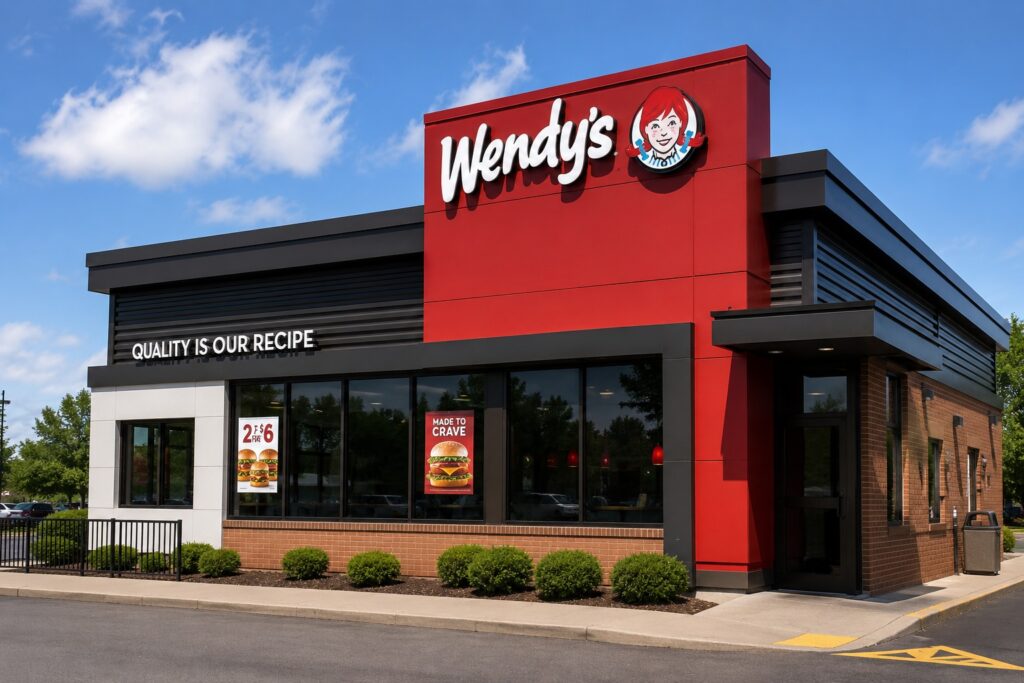
Here is a strange pair of numbers. Wendy’s brand alone is appraised at $4.9 billion, ninth most valuable restaurant brand on earth. The stock market prices all of the company’s shares at about $1.4 billion as of late July 2026.
Can you really buy a whole company for a third of what its own logo appraises for? And if so, why hasn’t somebody done it?
Somebody may be trying. This year has handed this struggling burger stock: an activist billionaire shopping for takeover financing, a private equity spree in fast food, and a minor short squeeze that briefly turned Wendy’s into a meme.
Arbitrage, strictly defined, means capturing a riskless gap between two prices. Investors use the word more loosely for a mispricing that is expected to converge. What follows is the case in its most appetizing light, and the risks served straight. Grab a napkin and take this math to go.
How brand value works
Brand Finance, a brand value consultancy, judges a brand by asking what a company would pay to license the name if it didn’t own it. Take the sales the brand generates, apply a fair royalty rate, adjust for consumer sentiment, and discount that stream of payments to a present value. The inputs include sales forecasts and brand scoring, not the stock price, so the appraisal arrives independently of anything Wall Street thinks.
And the value here is very real. Wendy’s restaurants rang up $14.0 billion in sales in 2025 across more than 7,000 locations, nearly all owned by franchisees. Each of them sends Wendy’s royalties on every sale for the right to use the name. The brand is like a toll booth, and the traffic through it is enormous.
If the brand is worth nearly $5 billion, shouldn’t the company be worth at least that much?
Don’t forget about the debt
Now for the twist. Market cap prices only the equity, and Wendy’s has a lot of debt.
The company has borrowed about $2.7 billion through notes secured by its franchise agreements, real estate, and intellectual property, which means bondholders literally hold the brand as collateral. Count leases and total borrowings pass $4 billion, against roughly $116 million of book equity. On paper, about 96% of capital is debt. Add $3.8 billion of net debt to the $1.4 billion market cap, and buying every last piece of Wendy’s costs a bit over $5 billion.
All that debt turns the stock into a lever. When the value of the whole company moves a little, the equity moves a lot, in both directions.
That arithmetic lands on a delicious coincidence. The whole company sells for about $5.2 billion. The brand alone appraises at $4.9 billion. A skeptic will ask whether the appraisers simply peeked at the company’s price tag and copied it down. They didn’t. The two methods share ingredients rather than answers, and when a company is almost entirely franchised, the brand basically is the business, so two independent measurements of the same royalty stream ought to land close together.
The market charges you full price for the royalty engine and throws in everything else, the real estate under the restaurants, the company-run locations, a new deal to build 1,000 restaurants in China, like the toy at the bottom of the bag.
A strong brand provides some safety
Royalties come off the top line, not the bottom. Franchisees pay Wendy’s a percentage of every sale before covering their own rent, labor, and beef bills. Restaurant profits can get ugly while the royalty checks barely flinch.
The first quarter of 2026 demonstrated this live. US same-restaurant sales fell 7.8% and net income collapsed 42%, a genuinely bad quarter, yet total revenue still grew 3.3%. That resilience is the whole reason lenders accept a name over a door as collateral for billions.
The cash flow tells the same story. Operating income covered interest payments about 2.8 times over in fiscal 2025, the company produced $205 million of free cash flow, and the dividend, reset in early 2025 to a target of 50% to 60% of earnings, consumes roughly half that cash flow while yielding shareholders about 7.5%. Everyone in line gets paid, for now. History adds a mild comfort of its own, since fast food is traditionally where diners land when budgets tighten and foodservice declined in only two of the last six US recessions.
One caveat: bondholders have more senior claims than equity holders. If brand value degrades further, the stock should suffer first.
The prospect of a private buyout
Nelson Peltz’s Trian Fund Management owns about 16% of Wendy’s, holds board seats, and has stopped being subtle. In a February 2026 filing, Trian called the stock undervalued and disclosed talks with financing sources about deals including an outright acquisition. By May, the Financial Times reported Trian was recruiting outside investors, including Middle Eastern backers, to fund a bid to take the company private. Shares jumped double digits on the report. Peltz kicked these tires once before, in 2022, so his appetite has a history.
None of this guarantees an offer. It does mean the company’s largest shareholder has spent months assembling one, with a view from inside the boardroom that no outside buyer gets.
Using Pizza Hut as a comparison
In June, Yum Brands sold Pizza Hut for $2.7 billion, with the business outside China going to LongRange Capital, a private equity firm. Apollo and Sycamore reportedly explored bids of their own.
Pizza Hut spent years losing ground to Domino’s, and after all the damage it still garnered $2.7 billion in cash. Famous restaurant brands can absorb a beating, keep substantial value, and transfer to owners who believe they can do better.
But Pizza Hut is a sobering warning. Brand Finance appraised it at $4.9 billion, the same value as Wendy’s, and the entire business sold for $2.7 billion.
So the bull case must argue that Wendy’s deserves more per royalty dollar than Pizza Hut fetched. There is material to work with, including the real estate, a burger category in better health than dine-in pizza, and that China pipeline. The argument exists. Someone still has to make it, and then pay for it.
A short squeeze wildcard
By mid-June, 38% of Wendy’s tradable shares were sold short, climbing toward 44% by some counts. Business Insider crowned the late June rally, a gain of more than 25%, as the market’s latest short squeeze. Wendy’s became a meme.
If a real offer lands, shorts covering nearly half the float would scramble for shares against an announced deal price, inside a stock where the largest holder already locks up 16% of the supply. Announcement day could overshoot any negotiated premium.
Best-case scenarios for the stock
The ordinary good outcome is a negotiated take-private at a conventional 25% to 40% premium, which flows entirely to stockholders. A premium gets paid only on the shares, while lenders simply get repaid what they are owed. So a buyer offering stockholders 30% more, roughly $400 million, raises the total cost of the company by only about 8%, which is what makes leveraged equity cheap to acquire and rewarding to sell.
The better outcome is a bidding war. One credible offer for a famous franchised brand tends to invite others, and Pizza Hut drew multiple financial buyers before LongRange won. When restaurant deals turn competitive, premiums can stretch. Jack in the Box paid about 66% above the prior close for Del Taco in 2021. A contested Wendy’s could plausibly land in that neighborhood.
The quiet outcome needs no deal at all. If Project Fresh, the company’s turnaround plan, stabilizes sales, the cushion holds the floor while the lever amplifies any recovery. A modest 15% markup of the whole enterprise could lift the stock by more than half. And the reset dividend pays roughly 7.5% during the wait, which beats waiting for free.
Stack a bidding war onto a heavily shorted stock and an outcome near double today’s price within a year or two sits inside the plausible range. Notice the fine print on that ceiling, though. It requires the transaction far more than the turnaround, which is exactly what makes this a speculation rather than an investment.
The risks are very real
Transactions fail to materialize all the time. Peltz examined this exact deal in 2022 and no offer followed. If none follows now, the stock falls back on a business still shrinking. US same-restaurant sales fell 7.8% last quarter, net income dropped 42%, and the interim chief executive calls this the early stages of a turnaround. Early stages don’t always progress. The company is closing its weakest restaurants, which strengthens the system eventually while shrinking today’s royalty base. The cheap-eats playbook has wobbled lately, with pinched diners skipping the drive-thru for the grocery store.
Interest coverage of 2.8 times in fiscal 2025 thinned to about 1.9 times in the first quarter of 2026. December’s refinancing priced at 5.4%, above the 2.4% to 4.5% coupons on most existing notes, so every maturity that rolls at today’s rates leaves less for stockholders. The dividend was already cut once, in early 2025, from $1.00 to $0.56 per share. Boards that cut once can cut again, and a 7.5% yield partly measures the market’s suspicion that this one will.
The $4.9 billion is an appraisal built on sales forecasts, and if sales keep sliding, appraisers mark brands down just as markets mark stocks down. The cushion is the royalty stream itself, not a number printed in a ranking. The squeeze cuts both ways too, since crowded trades unwind violently in either direction, and buying after a squeeze means paying prices the squeeze invented. If royalties erode and no buyer steps forward, the same leverage that could double this stock can carry it toward zero.
Too speculative for arbitrage
True arbitrage needs a locked-in spread, and nothing about Wendy’s is locked in. This is a risky speculation with a wide range of outcomes, from a lucrative buyout to a slow slide toward zero, and nobody should mistake it for a sure thing.
It is, however, exactly the kind of situation we enjoy digging into. At Magnifina we practice real investing, built on our own research into the businesses behind the tickers, with portfolios shaped around each client’s actual circumstances and comprehensive financial planning to make the fit precise. We do not recommend trades like this one for typical clients. For the curious, though, we are always glad to talk an idea like this through and see what our research turns up.
See whether we’re a good fit. Four questions, about a minute.
The Wendy's Trade FAQ
Why is Wendy's brand worth more than its market cap?
A market cap counts only the equity. Wendy’s carries about $3.8 billion of net debt secured by the brand itself, so buying the whole company costs roughly $5.2 billion, close to the $4.9 billion brand appraisal. The gap mostly lives inside the debt, not in an overlooked bargain.
Is Nelson Peltz taking Wendy's private?
Nothing is announced as of mid-2026. Trian owns about 16% of the company, told the SEC in February that the stock was undervalued while disclosing talks with financing sources, and was reported in May to be recruiting outside investors for a possible bid. Peltz explored the same move in 2022 without making an offer.
What is Wendy's short interest?
Short interest reached 38% of the float by mid June 2026, with some July estimates near 44%. Business Insider described the late June rally, a gain of more than 25%, as the market’s latest short squeeze.
What does the Pizza Hut sale mean for Wendy's?
Yum sold Pizza Hut for $2.7 billion in June 2026 even though Brand Finance appraises that brand at $4.9 billion, the same figure it assigns Wendy’s. The deal proves private equity wants tired restaurant brands, and it warns that appraisals run above what buyers actually pay.
Is Wendy's dividend safe?
Safe is a strong word. The board already cut it from $1.00 to $0.56 per share in early 2025, resetting the payout to 50% to 60% of earnings. The current dividend consumes roughly half of 2025 free cash flow and yields about 7.5%, a yield that partly reflects market doubt about whether it lasts.